Now that we mentioned the toaster, this is one example of currents being transformed into heat. Two other everyday examples are the bar heater and the electric cooker.
Currents and magnetic field are two sides of the same coin. The relationship between currents and magnetic fields was first discovered in 1820 by the Danish scientist H. C. Ørsted and his original experiment is simple to reproduce.
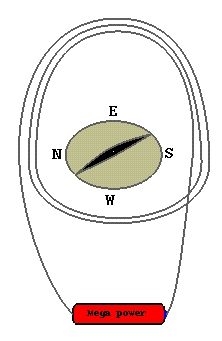
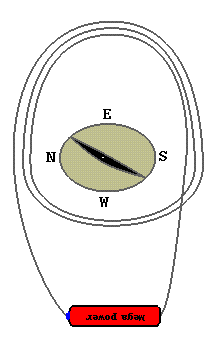
It requires a compass, a long thin electrical wire and a battery. Make a coil of the wire and connect the two ends to the battery. Hold the compass in one hand and notice in which direction North is. Next take the coil connected to the battery and move it in over the hand with the compass. You should now see that the direction of North shown by the compass has changed. If you change the connection of the battery and repeat the experiment you will find that the compass now rotates to the opposite side. This is because the current now runs in the opposite direction in the coils. The current is therefore generating a magnetic field that influences the compass.
But, the opposite is also the case. You can use a magnet to produce a current! This is basically what happens at a power plant or in a dynamo.
Go back to the previous page.